
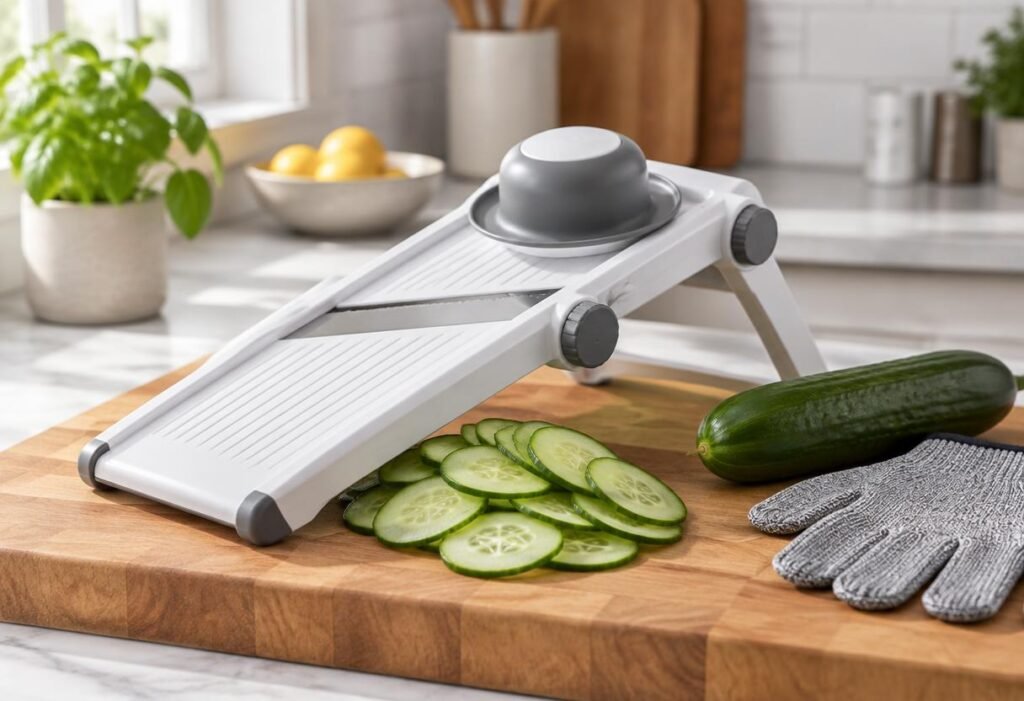
A mandoline slicer turns a potato into perfectly even chips in seconds, which is exactly why so many end up hiding at the back of a drawer. That blade is sharper than most kitchen knives, and it doesn’t care whether it’s slicing a cucumber or a knuckle. Learning how to use a mandoline slicer safely comes down to a few habits, and once they stick, it becomes one of the fastest tools in your kitchen.
Table of Contents
- Why Mandolines Deserve Respect
- What You Need Before You Start
- How to Use a Mandoline Slicer Step by Step
- Choosing the Right Thickness
- When to Stop Slicing
- Cleaning and Storing the Blade Safely
- FAQ
- Slice Smart, Stay Safe
Why Mandolines Deserve Respect
A mandoline works by sliding food over a fixed blade at speed. That motion is fast and repetitive, and the food gets smaller with every pass, which pulls your fingers closer to the edge. Injuries are common enough that, as Chowhound reports, close to 22,000 people visited US emergency rooms in 2011 because of slicers and choppers like these.
None of that means you should avoid one. It means you set it up properly and never rush.
What You Need Before You Start
- The mandoline itself, on a flat, dry surface.
- The hand guard (food holder) that came with it.
- A cut-resistant glove for the hand that holds the food. It is the single best safety upgrade for a few dollars.
- A cutting board or bowl underneath to catch the slices.
How to Use a Mandoline Slicer Step by Step
Here is how to use a mandoline slicer without drama:
- Set it on a stable surface. Use the fold-out legs or rest it across a bowl. If it slides, put a damp towel underneath.
- Choose your blade and thickness before any food goes near it, and lock the setting in place.
- Prep the food. Trim the end of a long vegetable so it has a flat face to slide on, and cut very large items in half.
- Attach the hand guard. Push its spikes into the food so you hold the guard, not the vegetable.
- Put on your glove and hold the mandoline by its handle with your other hand.
- Slide in smooth, even strokes. Use steady, light pressure away from your body. Let the blade do the work; pressing harder only makes slices uneven.
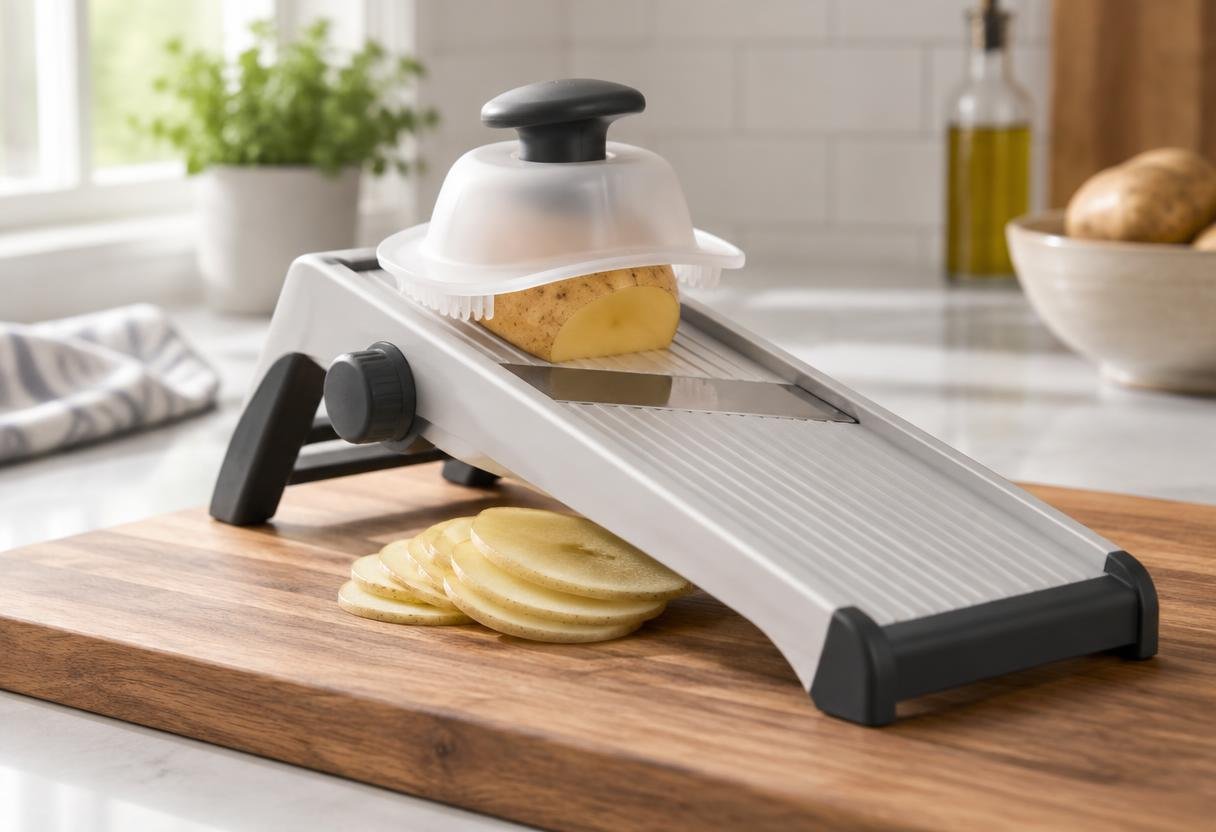
Most of what goes wrong comes from skipping step four. Knowing how to use a mandoline slicer with the guard every single time is the habit that protects your fingers.
Choosing the Right Thickness
- Paper-thin (about 1 mm): cucumber salads, radishes, onions for pickling.
- Thin (2 to 3 mm): potato chips, zucchini ribbons, apples for tarts.
- Medium (4 to 6 mm): gratins, scalloped potatoes, eggplant for grilling.
- Julienne blade: carrots and peppers for slaws and stir-fries.
Firm produce like potatoes, carrots and apples slices best. Soft tomatoes tend to squash; a sharp serrated knife does a better job there.
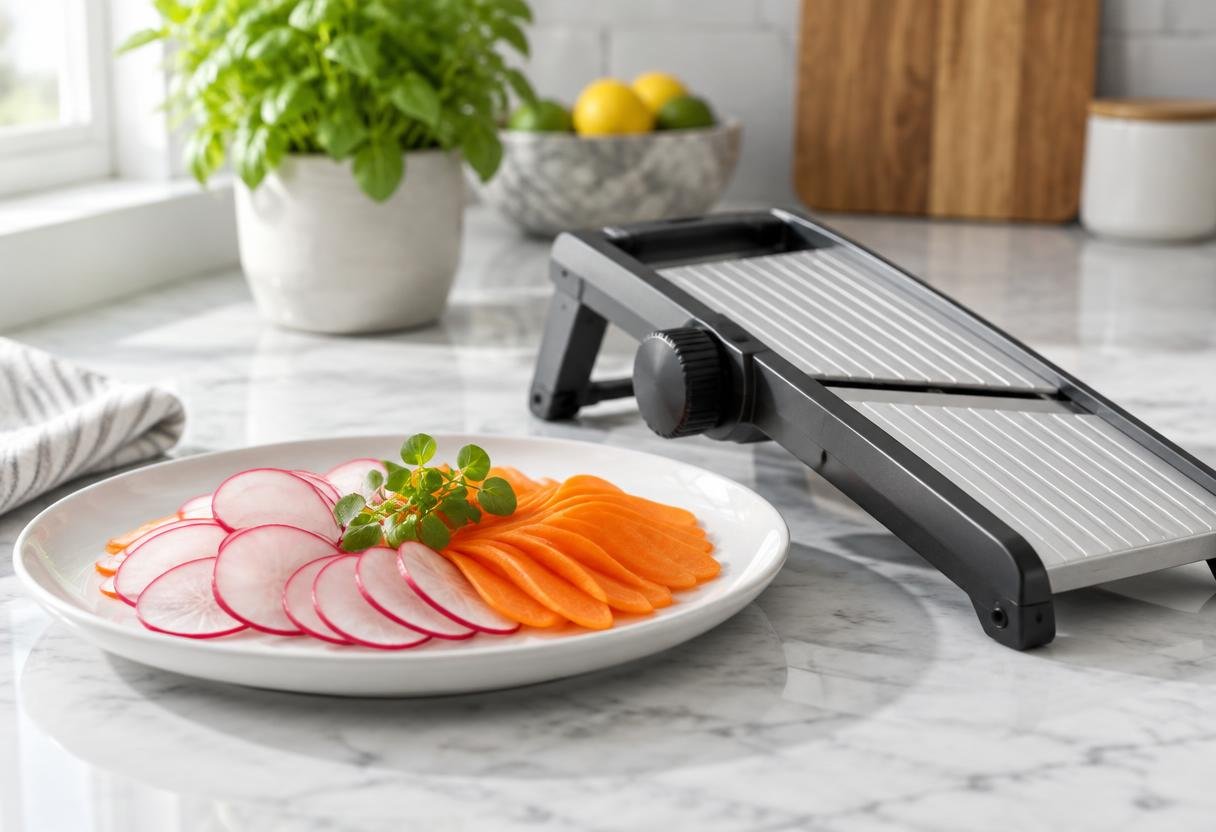
Here’s a quick reference for matching thickness to the dish. Start thicker if you’re new to mandolines, since thin settings need the most care:
| Thickness | Good For |
|---|---|
| About 1 mm | Homemade chips, cucumber for quick pickles, paper-thin onion |
| About 2 mm | Salads, slaw and onion rings |
| About 3 mm | Scalloped or gratin potatoes, zucchini for layering |
| 4 mm and up | Roasting vegetables, apple slices for baking |
When to Stop Slicing
This is the part of how to use a mandoline slicer that most guides skip. When the food gets down to the last inch or so, stop. That small end is where nearly every cut happens, because the guard loses its grip and fingers creep in. Set the stub aside for stock or a salad and chop it by hand with a good kitchen knife.
Cleaning and Storing the Blade Safely
Treat cleaning as part of how to use a mandoline slicer safely. Rinse the blade straight away under running water, then wash it with a sponge held flat, wiping away from the edge, never along it. Many models are top-rack dishwasher-safe, which keeps your hands away from the blade entirely. Dry it fully and store it with the blade cover on, or with the blade folded into the body.
If your current slicer has a loose guard, a flimsy frame or no thickness lock, it may be time for an upgrade. Our picks for the best mandoline slicer under $20 focus on models with solid guards. If you mainly need diced vegetables, a vegetable chopper is a gentler option.
FAQ
Is it safe to use a mandoline without the hand guard?
Not with bare hands. If the guard won’t grip an awkward item, wear a cut-resistant glove and stop well before the end.
Do cut-resistant gloves make a mandoline completely safe?
No. They greatly reduce the risk from slips and glancing contact, but they are cut-resistant, not cut-proof. Keep using slow, controlled strokes.
Why are my slices uneven?
Usually from pressing too hard or changing pressure mid-stroke. A dull blade can also cause it; replace or sharpen it if slices start tearing.
Can I slice cheese or meat on a mandoline?
Firm cheese works on a thicker setting. Partly frozen meat can be sliced thinly, but check that your model is rated for it.
Slice Smart, Stay Safe
Now you know how to use a mandoline slicer safely: stable surface, guard on, glove on, smooth strokes, and stop before the end. Follow those steps every time and you get restaurant-style slices in a fraction of the time. Once you understand how to use a mandoline slicer properly, it stops being scary and starts being the tool you reach for first.